|
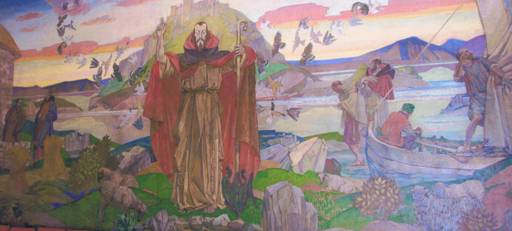

St Cuthbert
by Rev Michael Sadgrove
Read : The Good Shepherd (Ezekiel 34.11-16), The Lost Sheep (Matthew 18:12-14)
It is good to be here in this church whose spire I have often admired but which I had never seen inside until yesterday. I am especially glad to be here for this annual service of the Friends of St Cuthbert's. I bring you greetings from Durham Cathedral, also dedicated to St Cuthbert, and from the Cathedral's Friends (along with Christ and Blessed Mary the Virgin).
It's our privilege at Durham to be the home of Cuthbert's shrine which is the spiritual heart of the Cathedral. For many people it is one of this island's 'thin' places where the Spirit of God seems to be present in a palpable way, like Iona, Lindisfarne and other Christian sites. Once I was asked to take an elderly blind imam from Saudi Arabia round the Cathedral. The shrine is not a place where we encourage much talking, so I did not say anything as we climbed the steps into what we call the feretory where the shrine is situated. But as we got to the top, he said at once, 'Ah! I sense the presence of a holy man here, like our own shrines in Islam. Who is this and why is he here?' So I explained that the Cathedral, indeed the city of Durham itself, would not exist were it not for Cuthbert's body and the long journey his Saxon community made in the 9th and 10th centuries to find a new home for their saint safe from the Viking raids that were terrorising the coast of Northumbria.
We lingered for a while there: he was not in a hurry to leave. Afterwards, he gave me a copy of the Holy Qur'an with all the passages that speak well of Christians underlined. 'What about those that are hostile to Christians?' I asked. He replied: with your saint, you are people of the Book. We are all members of Abraham's community.' And I want to say, here at St Cuthbert's, that all the places that have a connection either with Cuthbert in his life time, as this ancient site perhaps has, or with the journey his coffin made for over a century are linked by a common memory and sense of belonging. Which is why I am so glad to be here today.
What do we love so much in our native northern saints: Aidan the gentle, Oswald the far-seeing, Hild the reconciler, Bede the wise, Margaret the generous? The treasured memory of Cuthbert can perhaps speak for them all. Here is one of Bede's stories about him. Cuthbert had gone out on one of his long journeys to preach, taking with him a boy for company. The day was long and the road steep, and they were tired and hungry. The boy grew worried. 'Learn to have constant faith and hope in the Lord' said Cuthbert. 'Whoever serves God shall never die of hunger.' They saw an eagle in the sky and Cuthbert said: 'God can send us food by that eagle.' Soon, by the river bank, they saw it settling on a rock. 'There is the servant I was telling you about. Run and see what God has sent and bring it quickly.' The boy returned with a big fish that the bird had caught. 'What?' said Cuthbert: 'Didn't you give the servant his own share? Cut it in two, and give half to the bird.' After a good meal of cooked fish with villagers nearby, Cuthbert praised God for his provision and said: 'Happy the one whose hope is in the Lord'.
That little tale shows something of what motivated Cuthbert. His was an intensely devoted spirituality. For him, to be human was to live in utter dependence on God, aware of his constant presence as something immediate and inescapable. We could call it a true simplicity, being pure in heart and poor in spirit. Perhaps only this can ever challenge what is broken and wrong in the world and in our communities and relationships. And the beautiful detail of his care for the eagle and his dinner speaks of a man profoundly connected to the natural world, in tune with God's creation. His reverence for life and his intimacy with nature makes him peculiarly attractive, in an age of environmental awareness, to all who want to treat all things living with courteousness which, for Christians, should mean all of us.
Bede sums up his character:
. . . like a good teacher he taught others to do only what he first practised himself. Above all else he was afire with heavenly love, unassumingly patient, devoted to unceasing prayer, and kindly to all who came to him for comfort…. His self-discipline and fasting were exceptional, and through the grace of contrition he was always intent on the things of heaven. Cuthbert was so skilful a speaker, and had such a light in his angelic face, and such a love for proclaiming his message… that all confessed their sins to him
Our readings today remind us what being a disciple means. It is not the fine phrases and rituals of religion, but the devotion to God that begins in the heart and issues in a life of compassion and service to humanity.
For Cuthbert, perhaps the image more than any other that inspired his extraordinary ministry was that of the Good Shepherd who lays down his life for the sheep. This familiar but striking picture no doubt draws on the passages we heard today. In Ezekiel, the context is the failure of human shepherds, the kings of Israel and Judah, to care and provide for the flock entrusted to them as they should have done. So God himself will take up that mantle: 'I myself will be the shepherd of my sheep;, and I will make them lie down, and seek the lost, and bring back the strayed, and bind up the injured, and strengthen the weak, and feed them with justice'. And this great promise is echoed in the gospel where Jesus says that to search for the 100th sheep that is lost is a mark of the shepherd who acts as God himself does, to whom every life is infinitely precious and valued.
For Cuthbert and his contemporaries, Christianity meant living in the spirit of those texts where dying to ourselves becomes the price we pay for embracing the gospel and surrendering our lives to God. The Book of Revelation speaks of those 'who loved not their lives even unto death', the martyrs who bore faithful witness to Christ. What the Benedictine vow calls conversio morum, the 'conversion of life' means a kind of martyrdom, a way of dying in order to live, losing our own selves in order to find them, laying down our lives like the Good Shepherd. This was how Cuthbert always was in his utter dependence upon God. I called it true simplicity just now, purity of heart: having only one thing as your goal and focus and aspiration in life. Buddhists call this being 'single-pointed'. Such people are blessed because they see God. Bede puts it this way: he
. . .was afire with heavenly love, unassumingly patient, devoted to unceasing prayer, and kindly to all who came to him for comfort…. always intent on the things of heaven
What is ministry, what is Christianity, what is true humanity if not that?
St Paul sums up his own ministry and apostleship:
as having nothing, and yet possessing everything
is how describes the life of those who have surrendered all to follow Jesus Christ and bear witness to him. Let me come back to this church and the Friends of St Cuthbert's. That name, 'the Friends of St Cuthbert's' reminded me of a sculpture by Fenwick Lawson that many of you will have seen in the parish church on Lindisfarne. There is also a bronze bust of it in Durham's Millennium Square. It is called 'The Journey' and shows six monks carrying Cuthbert's body on the 120 year pilgrimage from Viking-threatened Holy Island via southern Scotland, north Yorkshire and Chester-le-Street to Durham where the saint's body was finally laid to rest.
Perhaps the Society of the Friends of St Cuthbert's are like those first Saxon friends who bore his name and his memory, for whom their beloved saint's spirit of simplicity, humility and holy love inspired them to carry his body so long and so far. And if the Friends 'carry' him in this way, then so of course do our Christian communities dedicated to him: this church in Edinburgh and ours in Durham. To live in his spirit is to live in the spirit of Jesus himself, whose yoke is easy and whose burden is light.
For me, the gaunt stark slab in Durham Cathedral with his name on it says it all. The simplicity and lowliness of the shrine tells us in a place of power and majesty who and what is worth honouring. 'Whoever would be great among you, let them be your servant'. We know in our hearts that it is not status or wealth or achievement that matter, but becoming among the least by turning away from sin and being faithful to Christ.
The call, which belongs to all of us through baptism, is to give our lives to the project of purity and steadfastness, in the spirit of the saints 'willing one thing', wanting more than anything else the coming of God's reign of justice, peace, truth and love. For when God's kingdom comes it mends our brokenness, gives us back our dignity, and makes life wholesome and beautiful once more.
Amen! Come Lord Jesus!
| Rev Michael Sadgrove (Dean of Durham) October 2012 |
For all Church or calendar related issues, please contact :
 |
St Cuthbert's Parish Church. 5 Lothian Road. Edinburgh. UK. EH1 2EP |
| | | | |||||||||
|
|
|
|


|