|
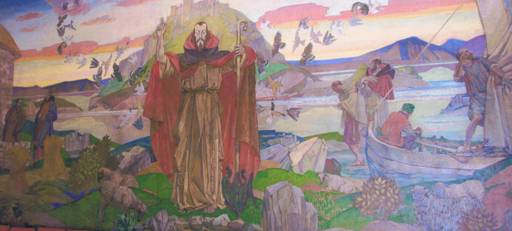

Cuthbert the Saint
by Rev Peter Neilson
In or around the year 634 AD, Cuthbert was born in the Lammermuir Hills region where he later worked as a shepherd.One night, by the River Leader, he became aware of a great light, stretching between earth and sky.The light faded and Cuthbert was left to wonder the meaning of the vision he had witnessed.
He later discovered that on that same night, 31st August 651, Aiden, Bishop of Lindisfarne, had died. To the young shepherd, the vision seemed to be a challenge and a call to serve God.That same year, he entered the Monastery of Old Melrose - one of the parent seats of the Celtic Church and founded by Aiden - and there he followed thirteen years of monastic life.
During this time, Eata, Abbot of Melrose, took Cuthbert with him to Ripon where they entered the monastery together.Cuthbert later returned to Melrose as Prior in 661.
In 664, the Synod of Whitby was held to settle the differences in church life between Celtic and Roman. Cuthbert, although trained in the Celtic Church, followed the decision of the Synod and accepted the Roman system.
Cuthbert was sent to Lindisfarne as Prior and won the respect of his monks and of the people he met in his mission work.On foot and on horseback he travelled the whole length and breadth of Northumbria which, at that time, stretched from the River Tees to the Firth of Forth.
He preached in Galloway, giving his name to the largest county, Kirk-Cuthbert, now known as Kirkcudbright. He was a missionary as well as a monk and won many for Christ through his conversations rather than by preaching.
Cuthbert was reputed to have the gift of healing and so, wherever he went, people would flock to him in scenes reminiscent of the Gospel Ministry of Jesus.Bede tells us that no one took home with them the burden that they came with.
Tradition has it that, on his journeys, Cuthbert stopped by the shores of the Nor' Loch just below Edinburgh Castle and built a little hut there.If this is so, the present day church of St Cuthbert stands on the same site as his early resting place.
He developed a desire to live a solitary life and so, alongwith some of his monks, he constructed a round cell and chapel made of stones and turf, six miles distance from Lindisfarne.He lived there for eight years, devoting his time to prayer.
He was consecrated Bishop on Easter Day, 685, at York and became Bishop of Lindisfarne, thus following in Aiden's footsteps.He died in 687 and was buried on 20th March in the little church of St Peter.
When the Danish raids against Northumbria were taking place in 698, Cuthbert's followers moved his remains and carried them from place to place for safety.In 883, they were buried in Chester-le-Street and, in 996, his remains finally came to rest in Durham.His shrine can be seen in Durham Cathedral.
We know that St Cuthbert's has long been the name of the Church here in Edinburgh because, in 1127, a Charter was granted by King David.It is the oldest document in Register House and shows that the Church existed even before then.
On the Sunday nearest to 20th March each year, our Parish Church lovingly remembers St Cuthbert at a special service.
Read Rev Peter Neilson's St Cuthbert's Day sermon:
"Cuthbert Calling"
Find out more about St Cuthbert by visiting The Medieval Sourcebook online:
"Bede: The Life and Miracles of St Cuthbert, Bishop of Lindesfarne"
Find out more about Lindisfarne by visiting the Lindisfarne "Holy Island" Web site at:
http://www.lindisfarne.org.uk
For all Church or calendar related issues, please contact :
 |
St Cuthbert's Parish Church. 5 Lothian Road. Edinburgh. UK. EH1 2EP |
 St Cuthbert's Church |
soul space |
OASIS |
Pilgrim Way |

Podcasts / Recordings |
 YouTube videos |
 Church of Scotland blogs |
 St Cuthbert's Church |

|