|

Saint Cuthbert of Durham (Part 3)
Several things were taking place at this time, and it is the meaning of these events that I want to explore in the remainder of this lecture.
First, we need to understand the nature of the Cathedral as a building. It was not a case of constructing a church and then placing a shrine within it. It was the opposite: building a great church in order to house a shrine, indeed we could say, building it around the shrine. This had been true of the White Church. It was pre-eminently true of the Norman Cathedral. It only exists because of the need to build a new and magnificent home for St Cuthbert. This was a shrewd move politically. Through the wanderings of his coffin and now through the shrine, Cuthbert was already a focal point for people across the north of England. To affirm his cult by the construction of a church on a scale hitherto unknown in this country was a way of pulling that wayward, indeed backward, part of England into consenting with, even welcoming, its new Norman overlords. To make friends with Cuthbert was a way of making friends with the people of Cuthbertsland. This is one reading, a more benign one, of the events in Durham after the Norman Conquest.
But there is another reading which puts Cuthbert in a more paradoxical context. The suppression of the Saxon community and the installation of Benedictine monks was not simply a religious act. It was an expression of Norman hegemony, an act of power and control. In the Wars of Religion of later centuries, a principle was established that largely created the map of modern Europe. It was expressed in the tag cuius regio, eius religio: whoever your ruler, you follow his religion. In the 16th century, whether you were catholic or protestant depended for most people not on personal choice but on whether your prince was catholic or protestant. It was the same in Norman England. The importing of the Benedictine rule was a way of imposing Norman religious attitudes and assumptions on to the life of the church in the north-east.
And these Norman ways were very different from the customs of the Saxon church which Cuthbert and his community knew. St Benedict, who had been educated in Rome, drew up his rule for monks in about 540, a century before Cuthbert's lifetime. His rule emphasised order, stability and pattern, a vision of a Christian society that drew on the remembered order, stability and pattern of the dying Roman Empire. Its spirituality was grounded on the practical realities of life in community based on the three priorities of prayer, study and work. This was the coenobitic way that proved so outstandingly successful in medieval Europe, especially in France, and that demonstrated time and again its capacity for self-renewal and reform, particularly in its Cistercian form. So to the Benedictines, St Cuthbert must have struck a rather odd figure. Not for them the extremes of ascetic devotion he was given to, like praying in the sea all night until the tide swirled up to his neck, or living in solitude on Inner Farne in an enclosure with walls so high that all he could see was the sky. In fact, Cuthbert has much more in common with the Irish saints, and before them, with the ascetic hermit traditions of St Anthony and the desert fathers than with the coenobitic way of the Benedictine rule. For this reason, the Benedictine Cathedral Priory at Durham would have struck Cuthbert as an unlikely, even an alien, place to lie.
And this is mirrored in how the building was intended to be read. Durham Cathedral is historically more than a great pilgrimage church. The power of the building is not only its consummate mastery of form, scale and proportion, or of the engineering principles of rib vault, flying buttress and pointed arch. It is also a symbol of the power of the Norman Conquest and of the William's bloodthirsty adventures in the north of England. The Cathedral, sitting on its acropolis along with the Castle, was in the strict sense of the word an offensive structure before it was defensive. It identified who England's new masters were and on whose side God and St Cuthbert now belonged. It stood for the political as well as the religious role of the church and particularly of the Norman bishops. It was a massive statement of Norman rule. It was an unambiguous symbol of power.
In this conflicted, power-obsessed world of the 11th century, the saint of Lindisfarne cuts a strange figure. It is hard to imagine a greater contrast between these two worlds: Durham Cathedral, in one sense a worldly symbol of sword and crown, frequented by kings and knights and armies, and the lonely cell on Inner Farne battered by wind and sea, and home only to birds and otters and one solitary hermit. We know that Cuthbert found even Lindisfarne too busy and crowded for him to realise his God-given vocation. This required remoteness and solitude: not for 'retreat' in the sense we understand it, a way of withdrawing from the world to find refreshment and renewal, but on the contrary, to enable him to focus in a concentrated way without distraction on the spiritual work of prayer and combating evil, not least his own demons. This was the reason he chose to live and die on the Farne.
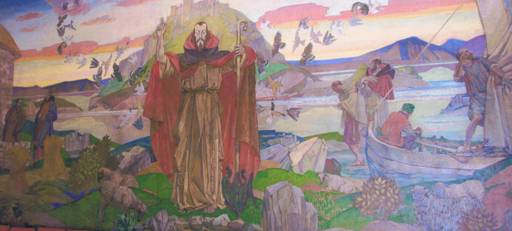
There are many traditions about Cuthbert that testify to his feeling for the natural world. Bede tells the story of a visit to Coldingham Priory, a mixed community of men and women where Aebba, a friend of Cuthbert's, was abbess. One night one of the monks saw Cuthbert leave the convent when he thought everyone was asleep, and go down to the beach. He entered the water and prayed there through the night. As he came out of the water at dawn, two otters were seen breathing on the saint's legs to warm him. Episodes like these have earned Cuthbert the epithet of England's St Francis. But I believe that Cuthbert's choice of Inner Farne was motivated by more than a love of nature. When you visit the Farne Islands, you are struck by the fact that dominating the Northumberland shore to the west lies Bamburgh Castle, the historic seat of the kings of Northumbria. That tells us that Cuthbert deliberately chose a site for his hermitage in full view of the political authorities of his day, as if to remind them daily that in ordering the affairs of human kingdoms, there is a heavenly kingdom to consider, a God to reckon with who claims the allegiance of all human subjects.
This, to me, underlines the paradox of Cuthbert's tomb at the heart of our Norman Cathedral. In one way, his entire career was profoundly counter-cultural to all that the Norman Conquest stood for. He would have been much troubled at the thought that his body would be imprisoned beneath the heavy stone vaults of a place so compromised by the principalities and powers of this world. His holiness and simplicity were fundamentally at odds with the sophisticated complexities of Anglo-Norman life, with the Priory's accumulation of wealth and status, and with the violent history with which it was associated. The powerful sense of permanence that the Cathedral evokes, its confidence that it will last for ever, exude a spirit very different from the lowly wooden churches and monasteries that Cuthbert and his peers inhabited.
Yet there is another perspective on this. Cuthbert was not unused to dealing with those in his day who wielded sword and sceptre in the royal courts. His was a spirituality of engagement with this world's agenda, not withdrawal from it. And to my mind, it is precisely the presence of Cuthbert in the midst of this marvellous yet ambiguous building that perhaps redeems it from being what it might have become: a temple to the hubris its builders, forever driven by the need to build bigger, higher, stronger and better than their rivals. No doubt there is something of William Golding's Dean Jocelyn in those who set out to build the great cathedrals of medieval Europe (I am thinking of his brilliant novel The Spire, an imaginative re-telling of the completion of Salisbury Cathedral, in which he explores how the motive of spiritual aspiration becomes fatally corrupted by vanity and self-aggrandisement in the building of England's highest medieval spire).
Cuthbert's shrine, then, puts a theological question to the Durham project. It gives it a conscience, a soul. Some would say that there is a contradiction between what he stood for and what the building consciously represented when it was built, that the shrine by its very existence subverts the meaning of a great church. I do not think that it does, but by criticising human self-assertion against the claims of God it does put the building of the Norman church into a larger context. It is as if the shrine is a kind of Inner Farne within the Cathedral, a constant and necessary reminder of where our true and ultimate accountability lies. In the real world, we all have to deal with priors and deans, with bishops and princes and warriors, but there is only one ultimate loyalty that we owe: to the living God himself. If we do not perceive and serve him in and through our negotiations with the ebbs and flows of human institutions, if we are blinded by those who wield power and hold our destinies in their hands, if we give our absolute allegiance to sword and crown, then we betray his trust.
I am aware of the risk, in saying this, that we romanticise the saints of the Saxon era and their Irish forebears. Those who lament the Synod of Whitby in 664, and its ruling in favour of the Roman tradition over the Irish, see the Norman Conquest as the last nail in the coffin whereby a holier, simpler, more beautiful form of Christianity was suppressed by an insitutional church that was worldly, corrupted and domineering. The label of 'Celtic' Christianity is often attached to that nostalgic vision of the spirituality of these islands when the church was young. As we all know, there is these days a considerable industry around 'Celtic' spirituality that is attractively and fragrantly packaged and marketed. Without criticising what many have found helpful, we do nevertheless need to recognise it for what it is: a re-invention for a postmodern generation of a way of faith that in its day was unbelievably, indeed for our day, an impossibly severe, astringent and demanding.
I doubt if we would easily find ourselves at home in the world inhabited by Patrick, Columba, Aidan, Oswald and Cuthbert. That world, from our vantage point, would seem bizarre, not to say extreme or even mad. So much the worse for us, we may say. But we can recognise that this process of 'reinventing' the saints was precisely what the Normans were doing with Cuthbert by placing his shrine at the heart of Durham Cathedral. What is more, we can see that this is not only inevitable but necessary. For as I have already said, Cuthbert had already become a distant memory by the time the Cathedral was built. Placing him within the frame of a Benedictine Cathedral Priory was a way of 'claiming' his universal significance for times very different from his own. It was, as I have said, a paradoxical thing to do. But it rescued him from the fate of being locked up in the remote past. It made him a contemporary of pilgrims of all ages. It enacted a constant theme of religious faith which is that what we receive, we hand on but not without contributing to it our own insight, devotion and meaning. This is the true meaning of traditio: a living body of faith that is given new significance through the act of cherishing it, and proclaiming it, and discerning new meanings in it in the light of altered circumstances and times.
| Rev Michael Sadgrove (Dean of Durham) October 2012 |
For all Church or calendar related issues, please contact :
 |
St Cuthbert's Parish Church. 5 Lothian Road. Edinburgh. UK. EH1 2EP |
| | | | |||||||||
|
|
|
|


|