Leaflets for Visitors
A Brief Tour
St Cuthbert's Parish Church. 5 Lothian Road. Edinburgh. UK. EH1 2EP
www.st-cuthberts.net
The Church - History and Origin
St Cuthbert's Church is thought to be the oldest ecclesiastical
site in Edinburgh. Tradition tells us that the Celtic missionary, Cuthbert,
preached from this spot in the 7th century and established the very first
church here, about 1300 years ago.
Since then there have been at least seven buildings on this site. However,
during that time the surroundings have changed considerably. Originally, the
church was on the shores of the Nor'loch, out in the countryside.
In 1760, when the New Town of Edinburgh was built and Princes Street
Gardens created, the area around St Cuthbert's then became a highly desirable
residential and shopping area.
|
Image from Edinburgh Library. |
The Current Church
The spire and Memorial Chapel below it, are the oldest part of
the current building, and all that remain of the 1775 church.
By the late 19th century the church was in a terrible state of disrepair,
and so the people of St Cuthbert's rebuilt their 18th century 'God-box' - which
was a very plain building.
The current building, which was designed by the architect Hippolyte Blanc,
was completed and dedicated in 1894. It hasbeen in constant use ever
since.
The building had a major refurbishment in 1990, when a new wall was built to
make the church smaller, and create a hall at the back of the church.
|
|
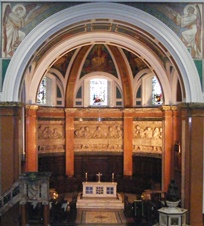
The Apse
In 1906, the Minister of the day - Dr James Macgregor -
celebrated 50 years of ministry. To commemorate this occasion, Dr Macgregor
commissioned the alabaster frieze on the wall of the apse. The design is based
on 'The Last Supper', by Leonardo da Vinci, and features Jesus and His
disciples. From left to right the characters are Bartholomew, James the Less,
Andrew, Judas Iscariot, Peter, John, Jesus, James, Thomas, Philip, Matthew,
Thaddaeus (aka Jude or Judas), and Simon.
Peter can be seen holding the sword with which he defended Jesus before his
arrest, and Judas Iscariot is holding a bag of money.
The three windows above the frieze, depict the life of Christ - his birth,
death and resurrection, with the painted ceiling above showing Christ as King
in glory - so encapsulating the whole of the Gospel.
The Communion Table, like the font and pulpit, is made from alabaster and
marble, mostly Italian, green and Egyptian. The middle of the Communion Table
shows the cross of St Cuthbert which can be seen in the décor in other
parts of the building.
|
 |
|
The Pulpit
To the left of the apse is the pulpit.
It is thought that the earliest church may have been built on the spot where
the pulpit stands today.
Under the pulpit is the foundation stone of the building along with a time
capsule containing documents and artefacts of the 1890's, including
photographs, coins, newspapers and copies of the Minister's sermons.
|
|
The Font
The font is a copy of Michelangelo's sculpture 'Madonna' which
is found in the Church of Our Lady in Bruges, Belgium.
It shows the child Jesus with his mother Mary, and represents 'Motherhood'.
It is an unusual representation, as the child is not held in his mother's
arms, but stands upright, almost unsupported, only loosely restrained by her
left hand, and appears to be about to step away from her and into the world.
Meanwhile, his mother does not cling to her son or even look at him, but gazes
down and away, as if she knows already what is to be her son's fate.
|
|
The Cuthbert Screen
On the south side (right hand side) above the balcony, is a
screen created by Edinburgh Art College in 1990. This contains a medallion
depicting the young Cuthbert as a shepherd boy.
|
|
Anam Chara Chapel
Below the screen, under the gallery is the Chapel of the Anam
Chara created in 1993. Anam Chara means "soul friend" in Gaelic. This
is a quiet space, set aside for prayer and reflection.
|
|
Stained Glass Windows
All along the south side of the church the windows depict New
Testament themes. On the opposite side, the windows depict Old Testament
themes.
The Tiffany window (in the gallery towards the back of the church), is one
of only four in Scotland made at the beginning of the 20th century by Tiffany
of New York. It shows the young David, sling in hand, setting out to the camp
of the Philistines to meet the giant Goliath. (More detailed information about
the stained glass windows is available in the 'Stained Glass Windows'
leaflet
|
|
Memorial Chapel
This is the ground floor of the steeple, the oldest part of the
church built in 1775. It is thought that this is on, or very near, the original
site on which St Cuthbert, a 7th century monk, built his original hut on a
journey from Melrose. This marked the beginning of Christian worship on this
site.
The entrance to the church was originally through a doorway in the wall that
faces you as you enter the chapel. It was subsequently remodelled as a memorial
to those who died in the First World War, and consecrated as a chapel in 1921.
The names lining the walls remember those who lost their lives in the First
World War. One of those named, is a nurse, Helena Bennet, who died on duty at a
camp of German prisoners in Oswestry during an epidemic of influenza. All of
the other names are men.
In 1930, the writer Agatha Christie married her second husband in this
chapel.
More detailed information about the Memorial Chapel, is available on our
website : HERE (http://www.st-cuthberts.net/memchapel.php)
|
|
Graveyard
A number of well-known people are buried in the graveyard that
surround the church. These include:
Rev David Williamson (1636 - 1706) believed to be the 'Daintie Davie' of
Scots songs, and a seven times married Minister of St Cuthbert's.
Alexander Nasmyth (1758 - 1840) a Scottish portrait and landscape
painter
George Meikle Kemp (1795 - 1844) the designer of Edinburgh's Scott
Monument.
James Findlay(1822 - 1862) was the first gunner to fire the one o'clock
gun from Edinburgh Castle.
More information on some of the more famous graves, is available on the
leaflet : Notable Monuments In The Churchyard
|
|
John Napier Memorial
A ornate memorial tablet to John Napier, can be seen in the
entrance hall on the north (left) of the main doors leading into the hall.
John Napier, was a Mathematician who lived in Merchiston Castle on the South
Side of Edinburgh. He became famous worldwide for his invention of logarithms.
When he died in 1617, he was buried near the West Port (or West Gate) of St
Cuthbert's church in a vault. However, the church has been rebuilt several
times since then and the surrounding ground taken over, so there is no way of
knowing exactly where his grave lies. His lasting legacy to Edinburgh is the
university. Napier University's main building surrounds his castle at
Merchiston on Colinton Road.
|
|
More detailed information about the history of St Cuthbert's Church, is
available on our website :
HERE (http://www.st-cuthberts.net/kirkhist.php)
|
